

Under-Sink vs Countertop RO System: Which Is Best for Your Home?
If you've spent an evening reading water filter reviews, you already know the drill: pitcher filters feel too slow and too basic, faucet-mount filters are hit or miss, and reverse osmosis — the technology that actually strips dissolved contaminants out of water — comes in two very different form factors. One lives in your cabinet. The other sits on your counter.
So which one belongs in your home?
The honest answer is: it depends on your kitchen, your water, and how you actually use water day to day. This guide walks through both designs from the inside out — how they filter, how they install, what they cost to own, and who each one genuinely fits. By the end you'll know exactly which one to buy, and why.
In a hurry? Here's the short version.
Quick answer
- Choose an under-sink RO system if you own your home, want whole-kitchen convenience, and need high daily output for cooking, drinking, and filling pots — the fastest, most hands-free option.
- Choose a countertop RO system if you rent, move often, have limited cabinet space, or want hot and cold purified water on demand without touching your plumbing.
- Both deliver RO-grade purification. The difference is capacity, installation, and lifestyle — not water quality.
Why more U.S. households are looking at RO right now
Two things changed the conversation about home water treatment in the U.S.
First, PFAS — the "forever chemicals" that have been linked to long-term health concerns — became regulated at the federal level. In April 2024, the U.S. EPA finalized its first national drinking water standard for PFAS, setting enforceable Maximum Contaminant Levels of 4.0 parts per trillion for PFOA and PFOS individually (EPA, April 2024). That's an extremely low threshold — low enough that many utilities are now actively telling customers what's in their water.
Second, aging infrastructure is still in the ground. The EPA estimates that up to 9 million homes are served through legacy lead pipes, which it is now working to replace over the coming decades (EPA, October 2024).
Here's the practical takeaway: water that meets a utility's legal limit isn't the same as water you feel good about pouring for your family. Carbon filters handle taste and odor. Reverse osmosis handles dissolved solids — lead, arsenic, PFAS, and much more — which is why RO has moved from "luxury upgrade" to "household default" in a lot of American kitchens.
Both designs in this article do that job. They just do it differently.
What an under-sink RO system actually is
An under-sink RO system installs inside your kitchen cabinet, connects to your cold water line, and runs purified water to a dedicated faucet at the sink. Nothing sits on your counter, and nobody in the household has to think about it. You open the tap, you get pure water.
The US1 Under-Sink Reverse Osmosis System is a good example of where the category has landed in 2026. A few things stand out:
- Dual RO membrane design at 0.0001 micron. The manufacturer pairs two RO membranes with a 360° swirl flow path and rates the system at 99.9999% contaminant reduction — covering PFAS and PFOA, lead, arsenic and other heavy metals, chlorine, chloramines and VOCs, bacteria, viruses, microplastics, and radioactive substances.
- 800 GPD output at 0.55 GPM. In plain terms, an 8 oz glass fills in about 5 seconds — fast enough to fill a pasta pot or a pitcher without standing around.
- Tankless build that reclaims cabinet space. Traditional RO systems hide a 2–4 gallon pressure tank under the sink. The US1 removes it entirely, which the manufacturer states recovers about 70% of the space a tanked unit would occupy — the difference between losing your cabinet and still storing your cleaning supplies in it.
- 3:1 pure-to-drain ratio. For every gallon sent to drain, three gallons come out purified — an improvement over the 1:3 or 1:4 ratios older RO systems are known for, which shows up on your water bill over a year.
- A smart LED faucet. Live TDS readings, a filter-life indicator, and color-coded status alerts, so you're never guessing when a cartridge is done.
- Zero-stagnant-water technology and 3-second filter swaps. Water doesn't sit idle in the system, so the first glass tastes as fresh as the last — and cartridges twist-and-pull out by hand, with no tools and no service call.
Installation uses standard 3/8-inch quick-connect fittings, which is why most handy homeowners treat it as a DIY weekend project rather than a plumber appointment.
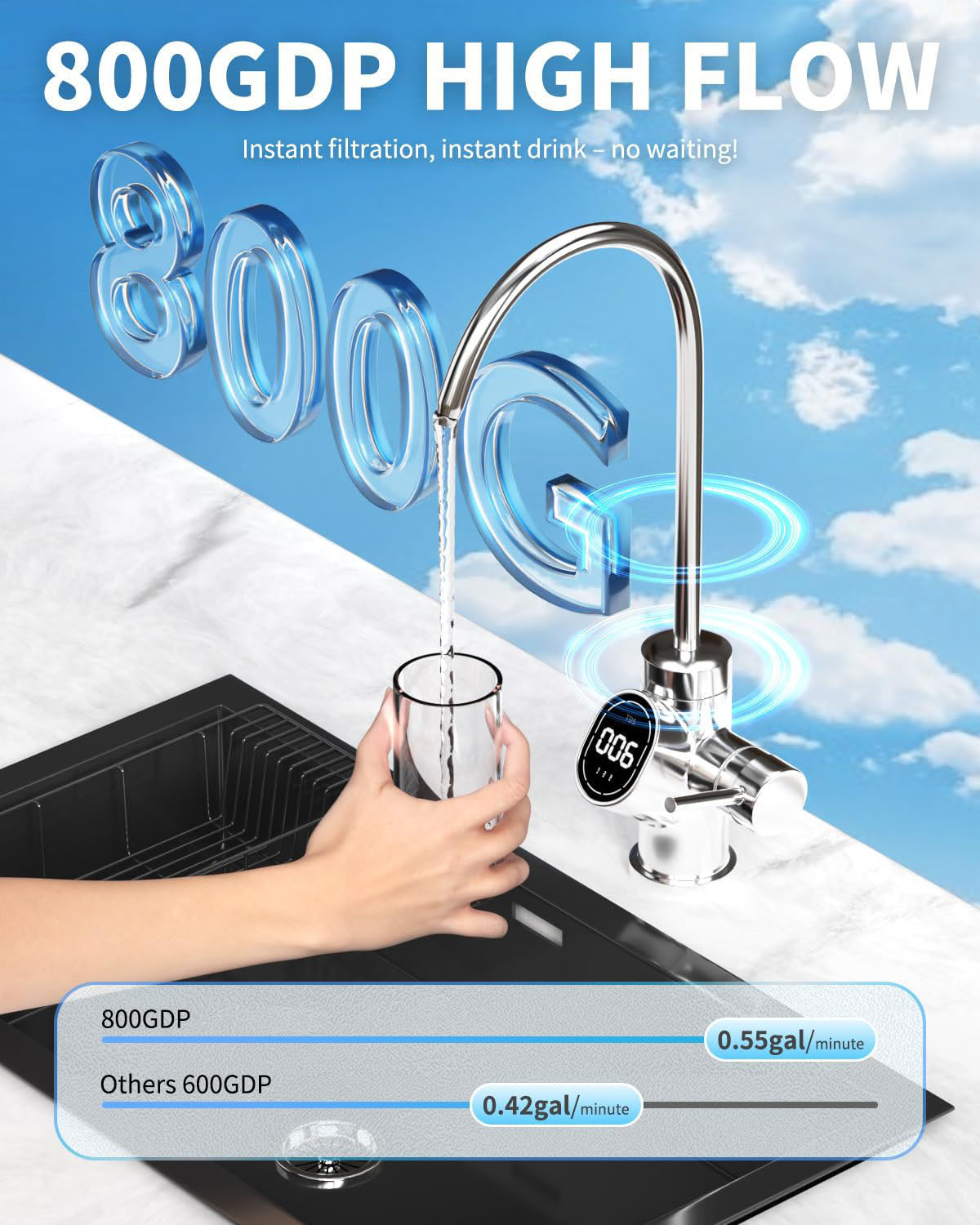
Best for: homeowners who want their main kitchen faucet to be a pure water faucet, and who use a lot of water for cooking.
What a countertop RO system actually is
A countertop RO system is a self-contained unit that sits on your counter, pulls water from a built-in tank you refill by hand, purifies it through RO, and dispenses it right there. No drilling, no plumbing, no landlord conversation.
The CT2 Cold and Hot Water RO Countertop Purifier Dispenser shows how far this format has come. It's no longer just a slow gravity-fed pitcher with a filter inside:
- Two cartridges: PPC (PP + AC) + RO. A 4-stage physical filtration system that intercepts impurities layer by layer, with the manufacturer rating the output at direct-drinking standard.
- Three functional configurations. Room-temperature water only; room-temperature plus cold; or room-temperature plus hot — so you pick the version that matches how your household drinks.
- Hot water in 3 seconds. Rare-earth thick-film rapid heating with stepless temperature adjustment, which means no kettle and no waiting.
- Cold water at 5 °C. Dual-channel semiconductor refrigeration, with customizable dispense volume so you can fill a glass or a bottle.
- Built-in UV sterilization and self-cleaning. The unit sanitizes on its own cycle and reminds you when filters are due.
- 5 L raw water tank + internal purified tank. You refill a pitcher-sized reservoir instead of tapping a water line.
- Integrated one-piece waterway. A sealed internal path reduces leak risk and keeps the footprint compact — roughly 187 × 450 × 409 mm, about the size of a small coffee maker.
The trade-offs are real and worth naming: output is slower (rated at roughly 0.26 L/min, or about 0.07 GPM, with a filter set rated for 2,000 L / ~528 gallons of purified water), and you refill the reservoir yourself. In exchange, you get zero installation and instant hot or cold purified water without a kettle, a fridge dispenser, or a plumbing project.
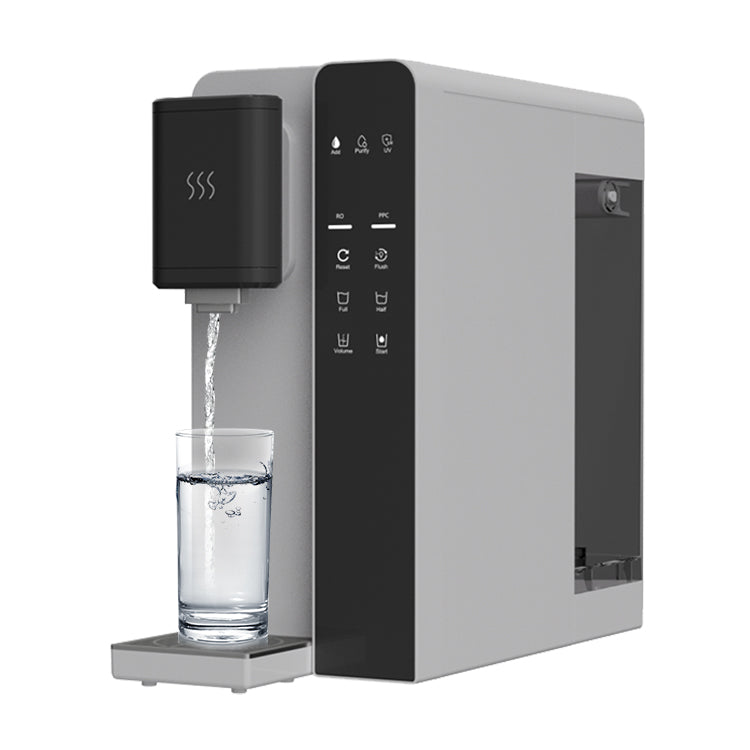
Best for: renters, apartment dwellers, dorm and office kitchens, small households, and anyone who wants hot and cold pure water without installation.
Head-to-head: the comparison that actually matters
| Factor | Under-Sink RO (US1) | Countertop RO (CT2) |
|---|---|---|
| Installation | Connects to cold water line; standard 3/8" quick-connect; typically DIY | None — plug in and fill the tank |
| Counter space | Zero (fully concealed in cabinet) | Occupies counter footprint (~187 × 450 × 409 mm) |
| Cabinet space | Tankless design, ~70% less than tank-style RO | Not applicable |
| Output | 800 GPD / 0.55 GPM — an 8 oz glass in ~5 sec | ~0.26 L/min, dispensed on demand |
| Filtration | Dual RO membrane, 0.0001 micron, rated 99.9999% contaminant reduction | 4-stage: PPC (PP + AC) + RO, direct-drinking standard |
| Water temperature | Single temperature at the dedicated faucet | Room temp, cold (5 °C), or hot (3-sec rapid heat) — model dependent |
| Water waste | 3:1 pure-to-drain | Not specified by manufacturer |
| Filter changes | 3-second tool-free twist-and-pull | Cartridge replacement with filter-life reminder |
| Monitoring | Smart LED faucet: live TDS, filter life, color alerts | Filter life reminder; self-cleaning cycle |
| Power | Runs on demand | 28 W room-temp mode; up to 1,680 W when heating |
| Ideal household | Homeowners, families of 3+, heavy cooking | Renters, 1–2 person homes, apartments |
| Current pricing | Listed on the product page | Listed on the product page |
Read that table once more and you'll notice the tie-breaker isn't filtration — both are RO, and both are rated to direct-drinking standard. The tie-breaker is how you live.
When an under-sink RO system is the better buy
Go under the sink if most of these sound like you:
- You use a lot of water. Cooking, rinsing produce, filling the coffee machine, refilling water bottles, making ice, mixing baby formula. A unit rated at 800 GPD and 0.55 GPM keeps up without a queue.
- You own your home. Drilling a faucet hole and tapping a supply line is a one-time task, and it adds to the kitchen rather than cluttering it.
- Counter space is precious. In a lot of U.S. kitchens, the counter is already hosting the air fryer, the espresso machine, and the toaster. A concealed system simply disappears.
- You want it invisible. No refilling, no reservoir, no visible unit. Water is just better — always.
- You care about water waste math. The 3:1 pure-to-drain ratio on the US1 is well ahead of older RO designs that send 3–4 gallons to drain for every gallon purified.
- You want maintenance to be trivial. Tool-free cartridge swaps in seconds mean the system gets maintained, instead of being ignored until the water tastes off.
Two practical notes before you buy. First, confirm you have a spare power outlet inside the cabinet — most modern tankless RO systems, including the US1, need one. Second, if you're on a septic system or have very high hardness, check the pre-filter and any softener recommendation with the supplier.
For the full spec sheet, in-box contents, and installation details, see the US1 Under-Sink RO System product page.
When a countertop RO system is the better buy
Go countertop if these sound more like you:
- You rent. No landlord approval, no plumbing modification, no hole drilled in anything you'll have to fix at move-out. You unplug it and take it with you.
- You want hot water too. This is the underrated advantage. The CT2 heats in 3 seconds with stepless temperature control and chills to 5 °C. That replaces a kettle, a water cooler, and a fridge dispenser in one footprint.
- You don't drink much water overall. A 2,000 L / ~528 gallon filter-set rating is generous for a one- or two-person household, and the slower flow rate is a non-issue when you're filling a glass.
- Your counter has room and your cabinet doesn't. Older apartments and galley kitchens often have the opposite problem from a suburban remodel.
- You move frequently. Job relocations, grad school, temporary housing — a countertop unit travels.
- You want a clean, appliance-style look. A modern countertop RO dispenser reads as a design object, not as water treatment equipment. It sits next to the coffee maker and looks like it belongs.
Worth knowing going in: you'll refill the raw water tank, you'll want a spot near an outlet, and the unit does take up counter real estate. Neither is a dealbreaker — but both are the kind of thing that annoys people who bought without thinking it through.
See the full feature set, dimensions, and power specs on the CT2 Countertop RO Purifier Dispenser page.
How to decide in five minutes
Answer these four questions in order. The first "yes" you hit usually settles it.
- Do you rent, or plan to move within two years? → Countertop.
- Do you need hot water from the same unit (tea, coffee, formula, instant meals)? → Countertop with a heating configuration.
- Does your household go through more than about one gallon of drinking water a day, or do you cook from scratch most nights? → Under-sink.
- Is your counter space already claimed? → Under-sink.
If you answered "no" to all four, you're in the pleasant position of choosing on aesthetics — both systems will cover your needs.
What actually drives cost of ownership
Purchase price is the visible number. The number that matters is five-year cost, and it's driven by three things:
- Filter replacement frequency. Both designs use cartridge systems with life indicators. A countertop unit with a 2,000 L / ~528 gal rated filter set and a two-person household might go a surprisingly long time between swaps; a busy family with an under-sink unit will cycle through cartridges faster — but typically pays less per gallon of water produced.
- Water waste. Older RO systems with 1:3 or 1:4 pure-to-drain ratios quietly inflate your water bill every single month. A 3:1 ratio — like the US1's — cuts that loss by roughly a factor of three to four. Over a year of daily use, this is not a rounding error.
- Service calls you avoid. Tool-free, twist-and-pull cartridges and self-cleaning cycles matter more than they sound. Systems that are easy to maintain get maintained; systems that aren't end up with degraded water quality and premature membrane failure.
One more variable: hot water. If your countertop unit saves you from running a 1,500 W kettle several times a day, the electricity comparison shifts in its favor — though the heating mode itself draws far more than the 28 W room-temperature mode.
A note for retailers, distributors, and private-label brands
If you found this article while researching what to stock rather than what to install, the same two form factors define the shelf.
Why both belong in a catalog: under-sink RO serves the homeowner-upgrade and new-construction segment, where buyers expect high output and are willing to install. Countertop RO serves renters, apartments, small households, and the "no installation" buyer — a segment that's growing faster than most plumbing-dependent categories. Carrying only one leaves half the demand to a competitor.
For a distributor or Amazon seller, the specs that convert are consistent across both: verified contaminant reduction claims, an honest GPD/GPM figure, a stated pure-to-drain ratio, tool-free filter changes, and visible quality monitoring (TDS display, filter-life alerts). Those are exactly the details buyers search for, and exactly the details that reduce returns.
Explore the complete range on the RO Water Purifiers collection page, which covers both under-sink and countertop configurations. The countertop lineup extends beyond the CT2 if you need different feature tiers for different price points — see the CT1 Reverse Osmosis Countertop, the CT4 Cold Water RO Countertop Dispenser, and the CT5 Cold and Hot Water RO Countertop Dispenser.
On the supply side, aiboaqua is operated by KANGCHENG INTERNATIONAL HK CO., LIMITED, with factories in Ningbo and Thailand, offices in Ningbo, Shenzhen, and Hong Kong, and a U.S. warehouse in California — which shortens lead times and simplifies fulfillment for American buyers. The facility is NSF-certified, and the program supports OEM/ODM work end to end: rapid prototyping, packaging design, NSF listing support, and Amazon FBA and global logistics. In other words, you're not limited to buying the catalog as-is.
For wholesale pricing, sample requests, or private-label inquiries, reach the team at sale@aiboaqua.com.
FAQ: Under-sink vs countertop RO systems
Do countertop RO systems need plumbing?
No. A countertop unit like the CT2 draws from a built-in raw water tank you refill by hand and runs on a standard outlet. Nothing connects to your water line, and nothing is drilled or modified — which is exactly why it's the practical choice for renters.
Is under-sink RO worth it compared to countertop?
It is if you want pure water at your main kitchen faucet with no refilling and higher daily output. The US1 delivers 800 GPD at 0.55 GPM with a tankless design that preserves most of your cabinet space. If you use water mainly for drinking and small pours, a countertop unit will do the job for less complexity.
Can I install an under-sink RO system myself?
In most U.S. kitchens, yes. The US1 uses standard 3/8-inch quick-connect fittings, includes installation hardware and a step-by-step manual, and fits a standard under-sink cabinet. If you're not comfortable tapping a cold water line, a handyman can complete it in well under an hour.
Do I need hot water from my RO system?
Only you can answer that — but if you boil a kettle several times a day for tea, coffee, or instant meals, a countertop dispenser with rapid heating (the CT2 heats in about 3 seconds with stepless temperature adjustment, plus 5 °C cold output) consolidates three appliances into one.
How often do RO filters need replacing?
It depends on water quality and usage. The CT2's filter set is rated for 2,000 L (about 528 gallons) of purified water, and both systems include filter-life reminders so you replace on schedule rather than on guesswork. Under-sink RO cartridges are tool-free twist-and-pull, so a swap takes seconds.
Which one should a retailer or distributor stock first?
Stock both. Under-sink RO serves homeowners upgrading their kitchen; countertop RO serves renters and small households who won't install anything. If you must choose, countertop is the lower-friction entry SKU for online channels — no installation barrier means fewer returns and a shorter path to a first review.
The bottom line
The under-sink versus countertop RO question isn't about which technology is superior — both use reverse osmosis to remove what carbon filters leave behind. It's about which one fits your kitchen and your habits.
Under-sink — the US1 Under-Sink RO System — wins when you own your home, use a lot of water, and want it all to be pure without thinking about it. High output, hidden installation, minimal waste.
Countertop — the CT2 Countertop RO Purifier Dispenser — wins when you rent, move, or want hot and cold purified water on demand without a single plumbing project.
Pick the one that matches how you actually live, and you'll stop thinking about your water — which is the entire point.